


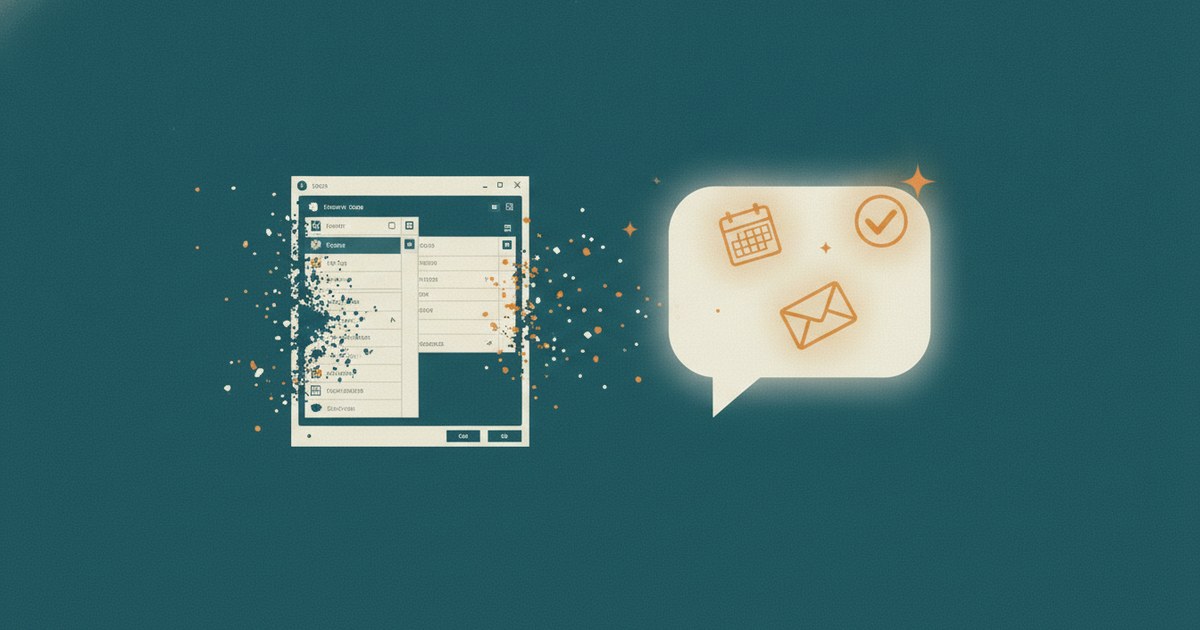
Think about the last new piece of software you learned. The path was probably the usual one: find where each menu lives, which button opens which screen, which tab hides the setting you need. Maybe you watched a YouTube tutorial. For forty years, using software meant learning the software's language.
AI is reversing that relationship. For the first time, the software learns your language. You say what you want, the way you would tell a person, and it figures out which buttons to press.
The change looks small, but it is as big as the jump from the command line to the mouse. And it is creating a new generation of products: AI-first and chat-first.
Three eras of the interface
The command era. In the 70s and 80s you had to memorize exact instructions. One wrong character and nothing happened. Software was for specialists.
The click era. Graphical interfaces brought windows, icons and menus. Anyone could use a computer, as long as they learned where things were. The whole industry began optimizing screens: where the button goes, how many clicks to finish a task, how to organize the menu.
The intent era. Now the starting point is not the screen, it is the goal. "Pay this bill on Friday", "move my dentist appointment to next week", "show me how much I spent on groceries this month". The interface stops being the path to the result and becomes the place where the result shows up.
What changes when software understands intent
Traditional software is a set of features waiting to be found. AI-first software is a set of capabilities waiting to be asked for. In practice, that brings four changes:
- No more learning curve. If you can explain what you want, you can use it.
- Hidden features surface. Almost nobody uses 80% of what an app offers, because they don't know it exists. When asking is enough, everything is one sentence away.
- Several apps become one conversation. A task that meant opening email, calendar, bank and WhatsApp becomes a single request.
- Software starts taking initiative. If it understands what is going on, it can warn you before you ask.
Who is already doing it
This is not theory. Several products were born with conversation at the center, each in its own territory.
ChatGPT and Claude showed the world you can talk to a machine about anything. For many people they became the first place to research, write and think out loud, before Google, before Word.
Perplexity rethought search. Instead of ten links to open one by one, you get the answer, with sources cited. "Searching" became "asking".
Cursor and coding agents changed how software gets built. The developer describes the change, and the agent reads the project, edits the files and runs the tests. The code editor is no longer just a place to type.
Lovable, Bolt and v0 brought the same idea to people who don't code: describe the app or website, and it appears, working, on the screen.
Intercom Fin and AI support agents transformed customer service. Customers write their own way and get the right answer, with no "press 1 for billing" tree.
Notion, Microsoft 365 Copilot and Google Gemini show the other path: established products adding a conversation layer on top of everything they already had. It works, but it has a natural limit. The conversation helps inside that ecosystem, and your life doesn't fit in a single ecosystem.
AI-first is not the same as "having AI"
This is the distinction that matters. Nearly every app today has a sparkle button promising "AI". That is AI as a feature: the product is still made of screens and menus, and AI is one more menu item.
An AI-first product is built the other way around. Conversation is the front door, and screens exist to review, adjust and visualize. Three questions tell them apart:
- Can you do everything by asking? Or does the AI only summarize and suggest, while the real work still happens in clicks?
- Does it act, or only answer? An assistant that explains how to pay a bill is useful. One that schedules the payment is a different category.
- Does it speak first? Traditional software waits for you to open it. AI-first software notices what is happening and tells you.
César: chat-first applied to your life
César was designed from day one around those three questions. Instead of an app with dozens of screens to learn, it is an assistant you talk to, mainly on WhatsApp, where you already spend your day.
You can do everything by asking. Bills, calendar, trips, packages, contacts, reminders, wish list: it all starts with a message. "Remind me to renew the car insurance in March." "How much is left to pay this month?" "Find a free slot on Thursday for lunch with Ana." The screens exist, but they are for checking, not for learning.
It acts. César doesn't explain how, it does it. It messages your contacts and brings back the answer. It calls to cancel an appointment. It edits videos and creates images. It reaches your computer to fetch a file. And when what you need doesn't exist, it builds a small custom app from a description.
It speaks first. Connected to your email, it finds bills and payment slips, tickets, bookings and tracking codes, and organizes everything on its own. Then it warns you at the right time: the bill due tomorrow, the delayed flight, the package out for delivery. With quiet hours and a daily briefing, so it helps without becoming noise.
The same model works for business. With César for Business, a small business owner asks "how much did I sell this week?" instead of building a report, and customers are served by an assistant that answers on WhatsApp and on the website using the company's real data.
What comes next
Menus won't disappear tomorrow, just as the keyboard didn't disappear when the mouse arrived. Screens are still great for seeing lots of information at once, comparing and fine-tuning. What changes is the order: first you say what you want, then the software shows what it did.
The most interesting consequence is who wins. In the click era, the people who mastered software were the ones with time to learn every tool. In the intent era, you only need to know what you need. It gives people their time back and puts advanced technology within reach of anyone who never wanted to become an app expert.
If you want to feel the difference, trying César is free and takes five minutes. Send the first message the way you would talk to a person and see what happens.